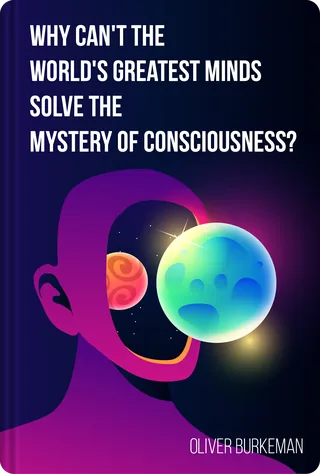
Why Can’t the World’s Greatest Minds Solve the Mystery of Consciousness?
Oliver Burkeman
Confront the enduring mystery of consciousness and the debate over whether subjective experience can ever be explained by the brain alone.
Listen to the intro
 Philosophy
 Science & Technology
 Psychology
Outline
What's it about?
Why Can’t the World’s Greatest Minds Solve the Mystery of Consciousness? (2015) examines one of the most difficult questions in philosophy and neuroscience: how physical activity in the brain produces the private experience of thoughts, feelings, colours, sounds, and self-awareness. Oliver Burkeman introduces the debate between researchers who believe consciousness can eventually be explained through brain science and thinkers who argue that subjective experience requires a broader explanation. The essay makes a complex intellectual debate accessible while showing why consciousness remains difficult to define, study, and fully understand.
Key ideas
- The core puzzle is how physical activity in the brain produces private experience such as thoughts, feelings, colours, sounds, and self-awareness.
- Some researchers believe brain science will eventually be able to explain consciousness.
- Other thinkers argue that subjective experience needs a broader explanation than the brain alone can provide.
- Consciousness remains hard to define, hard to study, and hard to understand fully.
- The book is an essay that makes a complex philosophical and scientific debate accessible to general readers.
About the author
Oliver Burkeman is a British author and journalist whose work explores psychology, productivity, time, happiness, and the limits of human control. He wrote a long-running column for The Guardian and is known for combining philosophical questions with practical observations about everyday life. His books include Four Thousand Weeks and The Antidote, both of which question conventional approaches to achievement and personal improvement.
Questions people ask
What is Why Can't the World's Greatest Minds Solve the Mystery of Consciousness? about?
It is a 2015 essay by Oliver Burkeman on how activity in the brain gives rise to the private experience of thoughts, feelings, and self-awareness. It lays out the debate over whether brain science alone can explain it.
Who is this book for?
It suits readers curious about philosophy, psychology, and the science of the mind who want a clear introduction to a difficult debate. No specialist background is needed, since the essay presents the arguments in an accessible way.
How long does the Durar summary take?
The Durar summary takes about 15 minutes to read or listen to. It covers the main positions in the consciousness debate and why the question is still open.
You May Also Like




More in Philosophy





Get the key ideas from the world's best books in about 15 minutes
Free account · One free summary every day