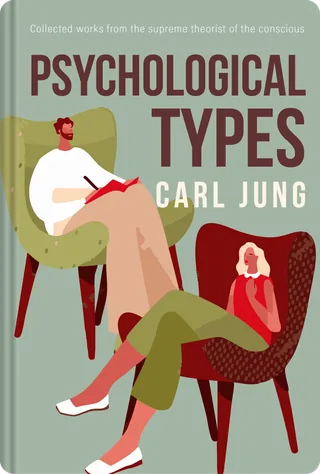
Psychological Types
Carl Jung
Understand how different personality types shape perception and decisions through ideas that transformed modern psychology and self-awareness.
Listen to the intro
 Personal Growth & Self-Help
 Philosophy
 Psychology
Outline
What's it about?
Psychological Types (1921) presents Carl Jung’s theory of personality based on two basic attitudes, introversion and extraversion, and four psychological functions: thinking, feeling, sensation, and intuition. Jung explains how these combine to shape the way people perceive the world and make judgements, and traces the idea of types through history, literature, and philosophy. The book later inspired widely used personality tools such as the Myers-Briggs Type Indicator.
Key ideas
- Jung's theory rests on two basic attitudes, introversion and extraversion, which describe how a person's energy is directed.
- Four psychological functions, thinking, feeling, sensation and intuition, shape how people take in the world and form judgements.
- These attitudes and functions combine in different ways, so each person perceives and decides in a distinct pattern.
- Jung traces the idea of personality types through history, literature and philosophy, not only through psychology.
- The book later inspired widely used personality tools such as the Myers-Briggs Type Indicator.
About the author
Carl Jung (1875–1961) was a Swiss psychiatrist and psychoanalyst who founded analytical psychology. After an early collaboration with Sigmund Freud, he developed his own ideas, including the collective unconscious, archetypes, and the process of individuation. His works include Psychological Types, Man and His Symbols, and Memories, Dreams, Reflections.
Questions people ask
What is the main idea of Psychological Types by Carl Jung?
Jung proposes that personality is shaped by two attitudes, introversion and extraversion, and four functions: thinking, feeling, sensation and intuition. Together they explain how people perceive the world and make judgements.
Who is Psychological Types for?
It suits readers interested in psychology, self-awareness and personal growth who want to understand how personality types work. It also helps those curious about the ideas behind tools like the Myers-Briggs Type Indicator.
How long is the Durar summary of Psychological Types?
The Durar summary takes about 15 minutes to read or listen to. It covers the core of Jung's theory of attitudes and functions.
You May Also Like





More in Personal Growth & Self-Help






Get the key ideas from the world's best books in about 15 minutes
Free account · One free summary every day