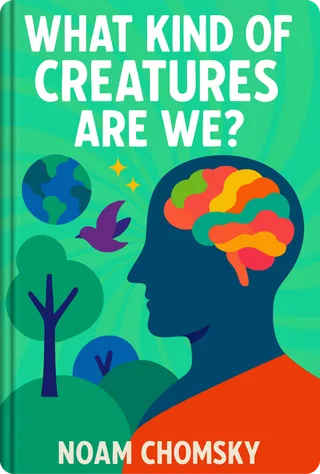
What Kind of Creatures Are We?
Noam Chomsky
Probe the mysteries of cognition, language, morality, and consciousness while confronting the limits of science in explaining what makes us human.
Listen to the intro
 Philosophy
 Society & Culture
Outline
What's it about?
What Kind of Creatures Are We? (2016) brings together Noam Chomsky’s reflections on some of the deepest questions about human nature. He explains his view that language is first of all an instrument of thought, built on an inborn capacity that all humans share, and explores what science can and cannot tell us about the mind. The book also considers the kind of society that best serves human freedom and the common good.
Key ideas
- Chomsky argues that language is first of all an instrument of thought, not merely a tool for communicating with others.
- Language rests on an inborn capacity that all humans share, which points to a common human nature.
- The book asks what science can and cannot tell us about the human mind.
- It also considers what kind of society best serves human freedom and the common good.
About the author
Noam Chomsky is an American linguist, philosopher, and public intellectual, often described as the father of modern linguistics. He spent most of his career at the Massachusetts Institute of Technology, where he developed influential theories about the structure of language and the mind. He has written more than one hundred books, including Syntactic Structures and What Kind of Creatures Are We?
Questions people ask
What is What Kind of Creatures Are We? about?
It collects Noam Chomsky's reflections on human nature, including language, the mind, the limits of science, and the kind of society that serves freedom and the common good.
What is Chomsky's main idea about language in this book?
He holds that language is first of all an instrument of thought, built on an inborn capacity that all humans share.
How long is the Durar summary of this book?
The Durar summary takes about 15 minutes to read or listen to. It covers the book's central questions about the mind, language and society.
You May Also Like
More in Philosophy
Get the key ideas from the world's best books in about 15 minutes
Free account · One free summary every day