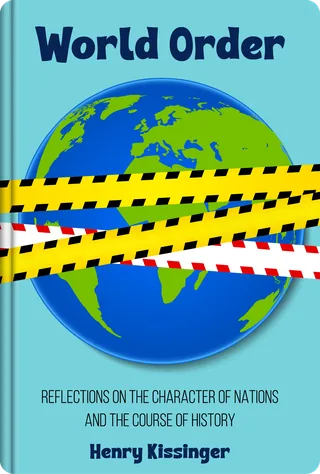
World Order
Henry Kissinger
Understand how diplomacy, power, ideology, and national interests have shaped global order across civilisations and history.
Listen to the intro
 Philosophy
 History & Politics
Outline
What's it about?
World Order (2014) examines how different civilisations have understood international order and why the world struggles to agree on shared rules today. Henry Kissinger traces the European balance-of-power system that grew out of the Peace of Westphalia, and compares it with the traditions of Asia, the Middle East, and the United States. The book asks how a stable global order can be built in an age of rising powers and new technologies.
Key ideas
- Different civilisations have understood international order in different ways, which is one reason shared global rules are hard to agree on today.
- The European balance-of-power system grew out of the Peace of Westphalia and shaped how states dealt with one another.
- Kissinger compares the European model with the traditions of Asia, the Middle East, and the United States.
- Rising powers and new technologies make building a stable global order harder than it was in the past.
About the author
Henry Kissinger (1923–2023) was a German-born American diplomat and political scientist who served as U.S. Secretary of State and National Security Adviser in the 1970s. He played a central role in American foreign policy during the Cold War and remained an influential voice on international affairs for decades. His books include Diplomacy, On China, World Order, and Leadership.
Questions people ask
What is the main idea of World Order by Henry Kissinger?
The book argues that civilisations have understood international order differently, which explains why the world struggles to agree on shared rules. It asks how a stable global order can be built in an age of rising powers and new technologies.
Who should read World Order?
It suits readers interested in history, geopolitics, diplomacy, and how nations pursue power and national interests. It also works for anyone who wants a long historical view of why global cooperation is difficult.
How long is the Durar summary of World Order?
The Durar summary takes about 15 minutes to read or listen to. It covers the book's main argument about the European balance of power and the order traditions of other regions.
You May Also Like







More in Philosophy






Get the key ideas from the world's best books in about 15 minutes
Free account · One free summary every day