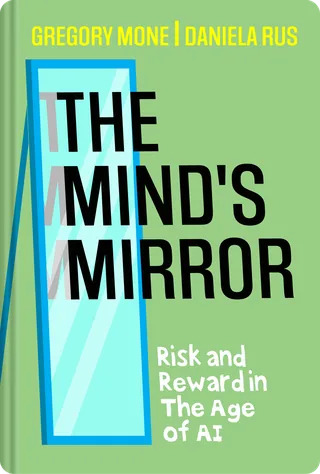
The Mind's Mirror
Gregory Mone and Daniela Rus
Explore how advanced AI mirrors human thinking and what it means for creativity, intelligence, technology, and the uniqueness of the human mind.
Listen to the intro
 Philosophy
 Money & Economics
 Science & Technology
 Psychology
Outline
What's it about?
The Mind's Mirror (2024) explores what artificial intelligence can and cannot do, and how it can work alongside people rather than replace them. Daniela Rus, one of the world’s leading roboticists, and science writer Gregory Mone explain how AI systems learn, where they excel, and where they still fall short. The book offers a balanced, hopeful view of how AI can extend human knowledge, creativity, and abilities.
Key ideas
- AI has real limits as well as real strengths, and the book sets out what it can and cannot do.
- The authors argue AI works best alongside people, extending what they can do rather than replacing them.
- Daniela Rus and Gregory Mone explain how AI systems learn, and where they excel and fall short.
- The book takes a balanced, hopeful view of AI as a way to expand human knowledge and creativity.
About the author
Gregory Mone and Daniela Rus bring together science writing and technology research. Rus is a Romanian-American roboticist and computer scientist who directs the Computer Science and Artificial Intelligence Laboratory at the Massachusetts Institute of Technology. Mone is an American science writer and author of books for adults and young readers.
Questions people ask
What is The Mind's Mirror about?
The Mind's Mirror (2024) looks at what artificial intelligence can and cannot do, and how it can work alongside people rather than replace them. It also explains how AI systems learn and where they still fall short.
Who wrote The Mind's Mirror?
It was written by Gregory Mone, a science writer, and Daniela Rus, one of the world's leading roboticists.
How long is the Durar summary of The Mind's Mirror?
The Durar summary takes about 15 minutes to read or listen to. It covers the book's main ideas on how AI learns, its strengths and limits, and how it can work with people.
You May Also Like
More in Philosophy
Get the key ideas from the world's best books in about 15 minutes
Free account · One free summary every day