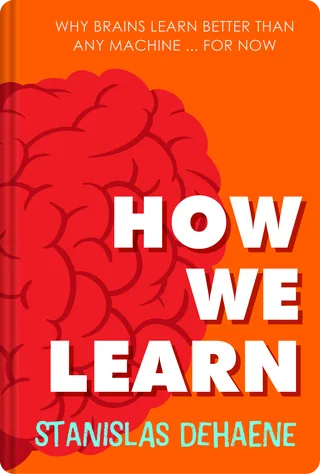
How We Learn
Stanislas Dehaene
Learn faster by understanding how attention, memory, and mastery work together to help your brain absorb and retain knowledge.
Listen to the intro
 Personal Growth & Self-Help
 Science & Technology
 Education & Creativity
Outline
What's it about?
How We Learn (2020) explains what brain science reveals about learning and how we can use it to learn better. Stanislas Dehaene describes the four pillars of learning: attention, active engagement, error feedback, and consolidation through sleep. He shows why the human brain is such a powerful learning machine and offers practical lessons for students, parents, and teachers.
Key ideas
- Learning rests on four pillars: attention, active engagement, error feedback, and consolidation through sleep.
- Brain science explains how we learn, and that knowledge can be used to learn better.
- The human brain is a remarkably powerful learning machine.
- Stanislas Dehaene offers practical lessons for students, parents, and teachers.
About the author
Stanislas Dehaene is a French cognitive neuroscientist and professor at the Collège de France who studies how the brain learns to read, count, and become conscious. He has chaired France’s scientific council for education and received many international awards. His books include Reading in the Brain, Consciousness and the Brain, and How We Learn.
Questions people ask
What is the main idea of How We Learn?
Learning depends on four pillars: attention, active engagement, error feedback, and consolidation through sleep. Understanding them helps you learn better.
Who is How We Learn by Stanislas Dehaene for?
It offers practical lessons for students, parents, and teachers, and suits anyone curious about how the brain learns.
How long is the Durar summary of How We Learn?
The Durar summary takes about 15 minutes to read or listen to, and covers the four pillars of learning and the lessons drawn from them.
You May Also Like

More in Personal Growth & Self-Help
Get the key ideas from the world's best books in about 15 minutes
Free account · One free summary every day