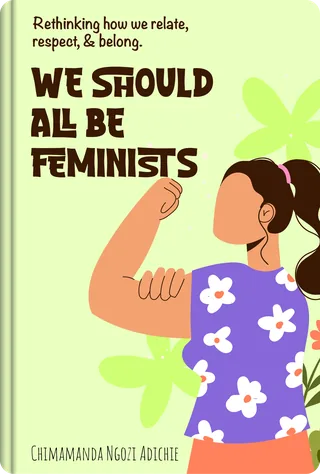
We Should All Be Feminists
Chimamanda Ngozi Adichie
Challenge outdated norms, amplify women’s voices, and help build a world where equality and respect are nonnegotiable.
Listen to the intro
 Personal Growth & Self-Help
 Society & Culture
Outline
What's it about?
We Should All Be Feminists (2014) is a short essay adapted from a popular talk by Chimamanda Ngozi Adichie. Drawing on her experiences growing up in Nigeria and living in the United States, she examines how cultural expectations shape the roles of men and women from childhood. She argues for a world in which both men and women are treated fairly and can reach their full potential.
Key ideas
- The book began as a popular talk and was adapted into a short essay published in 2014.
- Adichie draws on growing up in Nigeria and living in the United States to make her case.
- Cultural expectations shape what men and women are told to be, and this starts in childhood.
- Her central argument is that both men and women should be treated fairly and able to reach their full potential.
- Equality and respect are presented as standards that should not be up for negotiation.
About the author
Chimamanda Ngozi Adichie is a Nigerian novelist and essayist whose work has been translated into many languages. Her novels include Purple Hibiscus, Half of a Yellow Sun, and Americanah.
Questions people ask
What is We Should All Be Feminists about?
It is a short essay by Chimamanda Ngozi Adichie on how cultural expectations shape the roles of men and women from childhood. She argues for a world where both are treated fairly and can reach their full potential.
Who is We Should All Be Feminists for?
It suits readers interested in society, culture and identity, and anyone who wants to think about how expectations around gender are formed. Its central point is that fair treatment matters for both men and women.
How long is the Durar summary of We Should All Be Feminists?
The Durar summary takes about 15 minutes to read or listen to. It covers Adichie's main argument and the experiences in Nigeria and the United States that shaped it.
You May Also Like

More in Personal Growth & Self-Help

Get the key ideas from the world's best books in about 15 minutes
Free account · One free summary every day