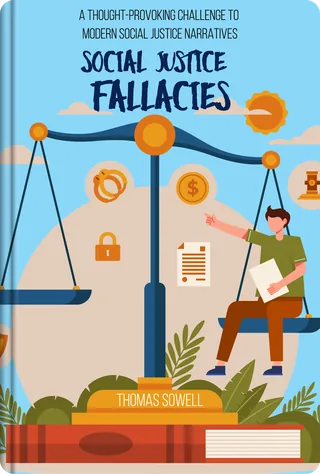
Social Justice Fallacies
Thomas Sowell
Challenge common assumptions about inequality through data and history, and explore why unequal outcomes do not always prove injustice or discrimination.
Listen to the intro
 Philosophy
 History & Politics
 Society & Culture
Outline
What's it about?
Social Justice Fallacies (2023) examines common assumptions behind debates about inequality. Thomas Sowell argues that differences in outcomes between groups and individuals are often explained by factors such as geography, culture, skills, and history rather than by discrimination alone. Using economic data and historical examples, the book challenges readers to test popular ideas against evidence before shaping policy around them.
Key ideas
- Unequal outcomes between groups and individuals do not automatically prove discrimination or injustice.
- Geography, culture, skills, and history often explain differences in outcomes better than discrimination alone.
- Economic data and historical examples can be used to test popular assumptions about inequality.
- Policy should be built on evidence rather than on ideas that merely sound convincing.
About the author
Thomas Sowell is an American economist, social theorist, and senior fellow at the Hoover Institution at Stanford University. Over a long career he has written more than forty books on economics, history, and social policy. His works include Basic Economics, Knowledge and Decisions, and Intellectuals and Society.
Questions people ask
What is Social Justice Fallacies about?
The book examines common assumptions behind debates about inequality. Thomas Sowell argues that unequal outcomes can have many causes and do not always point to discrimination.
Who should read Social Justice Fallacies?
It suits readers who want to test popular ideas about inequality against economic data and historical examples. It is especially relevant for anyone interested in how policy ideas are formed and judged.
How long is the Durar summary of Social Justice Fallacies?
The Durar summary takes about 15 minutes to read or listen to. It covers Sowell's main arguments about why outcomes differ and why evidence should come before policy.
You May Also Like

More in Philosophy





Get the key ideas from the world's best books in about 15 minutes
Free account · One free summary every day