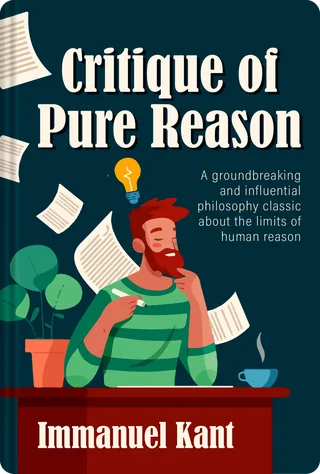
Critique of Pure Reason
Immanuel Kant
Explore the limits of human reason and how the mind actively shapes reality, transforming our understanding of knowledge and experience.
Listen to the intro
 Philosophy
Outline
What's it about?
Critique of Pure Reason (1781) asks what human reason can know and where its limits lie. Immanuel Kant argues that our knowledge does not simply mirror the world, because the mind actively shapes experience through space, time, and basic concepts such as cause and effect. The book transformed philosophy by showing why questions about God, the soul, and the universe as a whole lie beyond the reach of theoretical knowledge.
Key ideas
- The book asks what human reason can actually know and where the limits of that knowledge lie.
- Our knowledge does not simply mirror the world, because the mind actively shapes what we experience.
- Space, time, and basic concepts such as cause and effect are the tools the mind uses to shape experience.
- Questions about God, the soul, and the universe as a whole lie beyond the reach of theoretical knowledge.
- Published in 1781, the book transformed philosophy by redefining what knowledge and experience mean.
About the author
Immanuel Kant (1724–1804) was a German philosopher from Königsberg and one of the most influential thinkers of the modern era. His work reshaped the study of knowledge, ethics, and aesthetics. His major works include Critique of Pure Reason, Groundwork of the Metaphysics of Morals, Critique of Practical Reason, and Critique of Judgement.
Questions people ask
What is the main idea of Critique of Pure Reason?
Kant argues that the mind does not passively copy the world but shapes experience through space, time, and concepts like cause and effect. This also means reason has limits, and some big questions cannot be settled by theory.
Who is Critique of Pure Reason for?
It suits readers curious about philosophy, how the mind works, and how we know what we know. It is also useful for anyone interested in critical thinking and modern thinkers.
How long is the Durar summary of Critique of Pure Reason?
The Durar summary takes about 15 minutes to read or listen to. It gives you the core argument of Kant's 1781 book without needing to work through the full text.
You May Also Like







More in Philosophy







Get the key ideas from the world's best books in about 15 minutes
Free account · One free summary every day