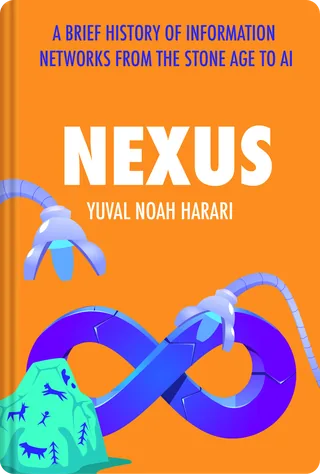
Nexus
Yuval Noah Harari
Trace how information networks, from language and writing to the internet and AI, built civilisations and continue to shape humanity’s future.
Listen to the intro
 Philosophy
 History & Politics
 Society & Culture
 Science & Technology
Outline
What's it about?
Nexus (2024) traces the history of information networks, from stories and written records to printing, mass media, and artificial intelligence. Yuval Noah Harari argues that more information does not automatically lead to truth or wisdom, and that information networks have often been used to build power and order. He warns that artificial intelligence may bring unprecedented risks and calls for strong safeguards.
Key ideas
- Nexus follows information networks through history, from stories and written records to printing, mass media and artificial intelligence.
- Harari argues that more information does not automatically lead to truth or wisdom.
- Information networks have often been used to build power and order, not only to spread knowledge.
- Artificial intelligence may bring risks unlike any seen before.
- Harari calls for strong safeguards around artificial intelligence.
About the author
Yuval Noah Harari is an Israeli historian and author who lectures at the Hebrew University of Jerusalem. His books on human history and the future have been translated into dozens of languages. His other books include Sapiens, Homo Deus, and 21 Lessons for the 21st Century.
Questions people ask
What is the main idea of Nexus by Yuval Noah Harari?
Harari argues that information networks have shaped civilisations, yet more information does not automatically bring truth or wisdom. He warns that artificial intelligence may bring unprecedented risks.
Who is Nexus for?
It suits readers interested in history, technology and society who want to understand how information networks, from writing to AI, shape power and the future.
How long does the Nexus summary on Durar take?
The Durar summary of Nexus takes about 15 minutes to read or listen to, and it covers the book's central argument about information networks and artificial intelligence.
You May Also Like



More in Philosophy



Get the key ideas from the world's best books in about 15 minutes
Free account · One free summary every day