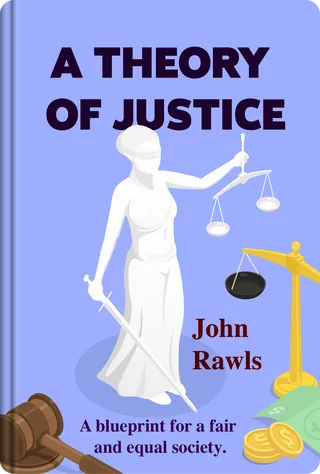
A Theory of Justice
John Rawls
Imagine a fair society built without privilege, where impartial laws protect freedom and recognise every person as a moral equal.
Listen to the intro
 Philosophy
 History & Politics
 Society & Culture
Outline
What's it about?
A Theory of Justice (1971) is one of the most important works of political philosophy of the twentieth century. John Rawls asks what principles a fair society should follow, and invites readers to imagine choosing them from behind a veil of ignorance, without knowing their own place in society. He argues for equal basic liberties for all and for arranging inequalities so that they benefit the least advantaged.
Key ideas
- A Theory of Justice, published in 1971, asks what principles a fair society should follow.
- Rawls invites readers to choose a society's principles from behind a veil of ignorance, not knowing their own place in it.
- Because no one knows their own position, the rules chosen have to be fair to everyone.
- Rawls argues that every person should have the same basic liberties.
- He holds that inequalities are acceptable only if they are arranged to benefit the least advantaged.
About the author
John Rawls (1921–2002) was an American political philosopher who taught at Harvard University for most of his career. He is widely regarded as one of the most influential philosophers of the twentieth century, and his ideas about fairness and justice shaped debates in philosophy, law, and economics. His books include A Theory of Justice and Political Liberalism.
Questions people ask
What is the main idea of A Theory of Justice?
Rawls argues that a fair society is one whose principles we would choose without knowing our own place in it. Such a society secures equal basic liberties and arranges inequalities to benefit the least advantaged.
What is the veil of ignorance?
It is a thought experiment in which you choose a society's rules without knowing your own position within it. Not knowing your place pushes you toward rules that are fair to everyone.
How long is the Durar summary of A Theory of Justice?
The Durar summary takes about 15 minutes to read or listen to. It covers Rawls's key arguments about fairness, liberty and inequality in plain language.
You May Also Like







More in Philosophy







Get the key ideas from the world's best books in about 15 minutes
Free account · One free summary every day