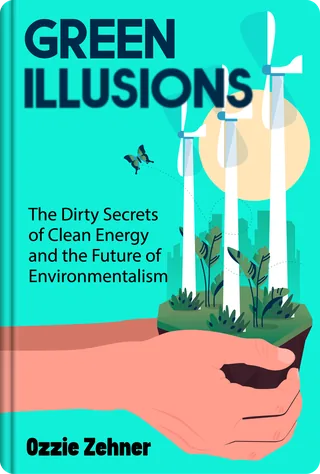
Green Illusions
Ozzie Zehner
Question whether green technology alone can solve the environmental crisis—and confront the deeper impact of overconsumption.
Listen to the intro
 Money & Economics
 Science & Technology
 Nature & the Environment
Outline
What's it about?
Green Illusions (2012) challenges the popular belief that solar panels, wind turbines, biofuels, and electric cars alone can solve our environmental problems. Ozzie Zehner shows the hidden costs and limits of these technologies and argues that reducing consumption, better city design, and wiser choices matter more than simply producing more clean energy. The book offers a thought-provoking look at what real sustainability requires.
Key ideas
- Solar panels, wind turbines, biofuels and electric cars on their own cannot solve our environmental problems.
- Green technologies carry hidden costs and limits that popular enthusiasm tends to overlook.
- Reducing consumption matters more than simply producing more clean energy.
- Better city design is a stronger lever for sustainability than adding new gadgets.
- Real sustainability requires wiser everyday choices, not just cleaner ways to power the same habits.
About the author
Ozzie Zehner is an American author, engineer, and researcher whose work focuses on energy, the environment, and technology. He has been a visiting scholar at the University of California, Berkeley. He is best known for Green Illusions, which questions common assumptions about clean energy, and for his work on the documentary Planet of the Humans.
Questions people ask
What is the main idea of Green Illusions?
Ozzie Zehner argues that green technology alone will not fix the environmental crisis. He says cutting consumption and designing better cities matter more than producing more clean energy.
Who is Green Illusions for?
It suits readers curious about energy, the environment and economics who want to question popular assumptions about clean technology. No technical background is needed.
How long is the Durar summary of Green Illusions?
The Durar summary takes about 15 minutes to read or listen to. It covers the book's central argument about the limits of green technology and the role of consumption.
You May Also Like






More in Money & Economics



Get the key ideas from the world's best books in about 15 minutes
Free account · One free summary every day