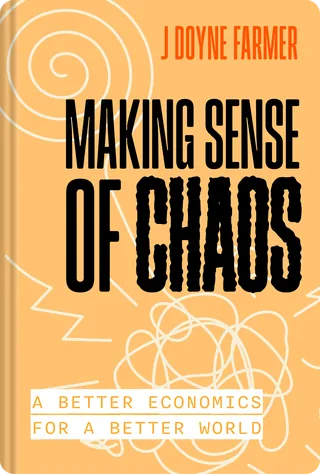
Making Sense of Chaos
J Doyne Farmer
Discover how complexity science reveals patterns within chaos, helping us understand economies, technology, and an unpredictable future.
Listen to the intro
 Money & Economics
 Society & Culture
 Science & Technology
Outline
What's it about?
Making Sense of Chaos (2024) argues that traditional economics often fails to predict crises because it assumes the economy is stable and predictable. J Doyne Farmer introduces complexity economics, which uses computer simulations of many interacting individuals and businesses to model how real economies behave. He shows how this approach can help us understand financial crashes, climate policy, and economic change.
Key ideas
- Traditional economics often fails to predict crises because it assumes the economy is stable and predictable.
- Complexity economics models the economy through computer simulations of many interacting individuals and businesses.
- Simulating how real people and firms behave helps explain how actual economies work, not how they should work in theory.
- This approach can help us understand financial crashes, climate policy, and economic change.
About the author
J Doyne Farmer is an American complex systems scientist and professor at the University of Oxford, where he directs research on complexity economics. He was a pioneer of chaos theory and later co-founded a successful quantitative trading company. Making Sense of Chaos brings together decades of his research.
Questions people ask
What is the main idea of Making Sense of Chaos?
J Doyne Farmer argues that traditional economics misses crises because it treats the economy as stable and predictable. He proposes complexity economics, which simulates many interacting individuals and businesses.
Who is Making Sense of Chaos for?
It suits readers curious about how economies work, why crashes happen, and how computer modelling can inform topics like climate policy. No economics background is needed to follow the summary.
How long is the Durar summary of Making Sense of Chaos?
The Durar summary takes about 15 minutes to read or listen to. It covers the book's argument for complexity economics and what it can explain.
You May Also Like







More in Money & Economics





Get the key ideas from the world's best books in about 15 minutes
Free account · One free summary every day