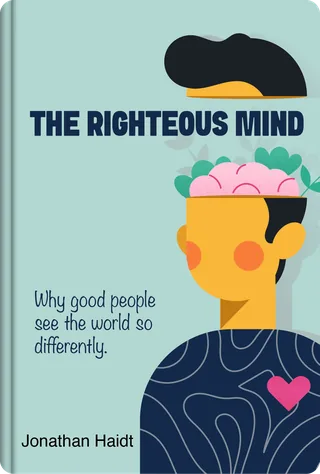
The Righteous Mind
Jonathan Haidt
Decode why good people disagree by exploring the moral instincts behind fairness, loyalty, authority, purity, liberty, politics, and religion.
Listen to the intro
 History & Politics
 Society & Culture
 Psychology
 Education & Creativity
Outline
What's it about?
The Righteous Mind (2012) explores why good people are divided by politics and religion. Social psychologist Jonathan Haidt argues that moral judgements come mainly from intuition, with reasoning following afterward, and describes several moral foundations, including care, fairness, loyalty, authority, and sanctity, that different groups emphasise in different ways. The book encourages readers to understand opposing views with greater empathy.
Key ideas
- Haidt argues that moral judgements come mainly from intuition, with reasoning arriving afterward to explain what we already feel.
- The book describes several moral foundations, including care, fairness, loyalty, authority, and sanctity.
- Different groups give different weight to these foundations, which helps explain why good people end up divided over politics and religion.
- Understanding the intuitions behind an opposing view makes it easier to approach people who disagree with you with empathy.
About the author
Jonathan Haidt is an American social psychologist and professor at New York University’s Stern School of Business. He studies morality, emotion, and culture, and his other books include The Happiness Hypothesis, The Coddling of the American Mind, and The Anxious Generation.
Questions people ask
What is the main idea of The Righteous Mind?
Jonathan Haidt argues that moral judgements come mainly from intuition, with reasoning following afterward. Groups emphasise different moral foundations, which is why good people can disagree so deeply.
Who is The Righteous Mind for?
It suits readers curious about why people divide over politics and religion, and anyone who wants to understand opposing views with more empathy. It is written by a social psychologist and draws on psychology.
How long does the Durar summary of The Righteous Mind take?
The Durar summary takes about 15 minutes to read or listen to. It covers Haidt's argument about moral intuition and the moral foundations that different groups emphasise.
You May Also Like






More in History & Politics










Get the key ideas from the world's best books in about 15 minutes
Free account · One free summary every day