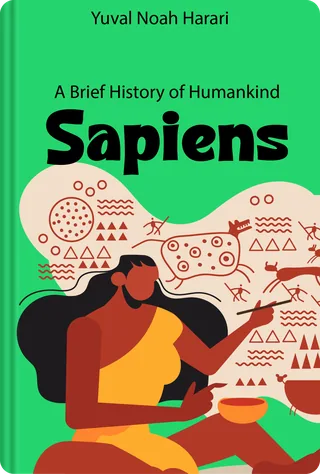
Sapiens
Yuval Noah Harari
Trace humanity’s rise through shared beliefs, cooperation, and technology while rethinking progress and our place in the future.
Listen to the intro
 History & Politics
 Society & Culture
Outline
What's it about?
Sapiens (2011) surveys the history of humanity from early communities to the interconnected societies of the modern world. Yuval Noah Harari examines how language, shared stories, agriculture, political institutions, trade, science, and technology shaped cooperation on a large scale. By moving across long periods of history, the book invites readers to question familiar assumptions about progress, power, happiness, and the choices that may shape humanity’s future.
Key ideas
- Sapiens covers human history from early communities to today's interconnected societies, moving across very long stretches of time.
- Language and shared stories helped people cooperate on a large scale, far beyond what small groups could manage.
- Agriculture, political institutions, trade, science, and technology each reshaped how people live and work together.
- The book asks readers to question familiar assumptions about progress, power, and happiness rather than take them for granted.
- Harari links the long past to the choices that may shape humanity's future.
About the author
Yuval Noah Harari is an Israeli historian, author, and professor whose work examines broad patterns in human history. He is known for connecting developments in politics, economics, culture, science, and technology through large historical narratives. His books have reached an international audience and have encouraged wide discussion about humanity’s past, present challenges, and possible futures.
Questions people ask
What is the main idea of Sapiens by Yuval Noah Harari?
Sapiens argues that language, shared stories, and institutions let humans cooperate on a large scale, and that this shaped everything from agriculture to modern technology. It also invites readers to rethink what progress really means.
Who is Sapiens for?
It suits anyone curious about world history, society, and anthropology who wants a broad view of how humanity got here. No background in history is needed to follow the big picture.
How long is the Durar summary of Sapiens?
The Durar summary takes about 15 minutes to read or listen to, in English or Arabic. It covers the book's main arguments about cooperation, progress, and the future.
You May Also Like






More in History & Politics









Get the key ideas from the world's best books in about 15 minutes
Free account · One free summary every day