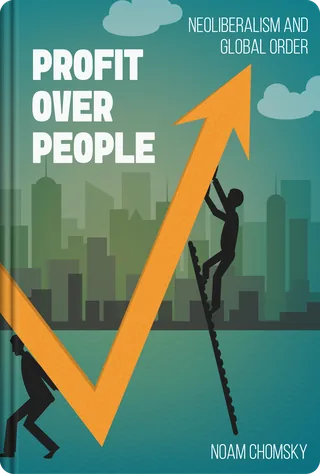
Profit Over People
Noam Chomsky
Examine how global capitalism concentrates power, deepens inequality, and places corporate profit above democracy, human rights, and public welfare.
Listen to the intro
 Philosophy
 Money & Economics
 History & Politics
Outline
What's it about?
Profit Over People (1999) is a sharp critique of the free-market economic policies that shaped the global economy in the late twentieth century. Noam Chomsky argues that these policies, often promoted as natural and inevitable, concentrated wealth and power in the hands of large corporations and weakened democracy. Through a series of essays, the book encourages readers to question how economic decisions are made and whom they serve.
Key ideas
- Free-market policies that shaped the late twentieth-century global economy are often presented as natural and inevitable, but they were choices.
- Chomsky argues these policies concentrated wealth and power in the hands of large corporations.
- The book contends that corporate concentration of power has weakened democracy.
- It asks readers to question how economic decisions are made and whom they actually serve.
About the author
Noam Chomsky is an American linguist, philosopher, and political commentator who spent most of his career at the Massachusetts Institute of Technology. He transformed the study of language with his theory of generative grammar and is also known as a prominent critic of foreign policy and corporate power. His books include Syntactic Structures, Manufacturing Consent, and Profit Over People.
Questions people ask
What is Profit Over People about?
It is a critique of the free-market policies that shaped the global economy in the late twentieth century. Noam Chomsky argues they concentrated wealth and power in large corporations and weakened democracy.
Who is Profit Over People for?
It suits readers curious about economics, politics and ethics who want to question how economic decisions are made. It is written as a series of essays rather than a technical textbook.
How long is the Durar summary of Profit Over People?
The Durar summary takes about 15 minutes to read or listen to. It covers the book's main argument about corporate power, democracy and who benefits from economic policy.
You May Also Like




More in Philosophy







Get the key ideas from the world's best books in about 15 minutes
Free account · One free summary every day