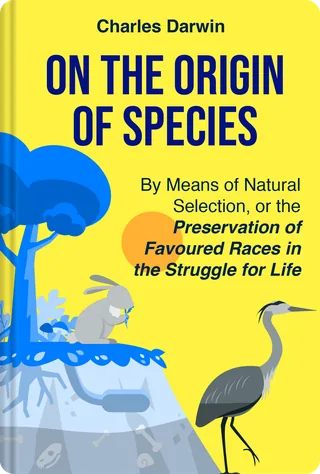
On the Origin of Species
Charles Darwin
Discover how natural selection drives evolution, shaping useful traits and creating the extraordinary diversity of life.
Listen to the intro
 History & Politics
 Science & Technology
Outline
What's it about?
On the Origin of Species (1859) presents Charles Darwin’s theory of evolution through natural selection, explaining how species gradually change across generations. Drawing on observations from nature, selective breeding, geography, and the fossil record, Darwin argues that organisms with traits better suited to their environments are more likely to survive and reproduce. The book transformed the study of life by offering a scientific framework for understanding adaptation, biological diversity, and the relationships among living organisms.
Key ideas
- Species change gradually across generations rather than staying fixed, and natural selection is the process Darwin proposes to explain that change.
- Organisms with traits better suited to their environment are more likely to survive and reproduce, passing those traits on.
- Darwin builds his case from several sources: observations of nature, selective breeding, geography, and the fossil record.
- Adaptation and the wide diversity of living things can be understood through one scientific framework rather than as separate puzzles.
- The book changed how life is studied by showing how living organisms are related to one another.
About the author
Charles Darwin was an English naturalist, geologist, and biologist whose research profoundly influenced modern science. His observations during the voyage of HMS Beagle helped him develop his ideas about natural selection and the gradual development of species. Through decades of careful research, he contributed to biology, geology, botany, and the scientific understanding of the natural world.
Questions people ask
What is On the Origin of Species about?
Published in 1859, it presents Charles Darwin's theory that species change gradually over generations through natural selection. Organisms better suited to their environments are more likely to survive and reproduce.
What evidence does Darwin use in the book?
He draws on observations from nature, selective breeding, geography, and the fossil record. Together these support his argument about adaptation and the diversity of life.
How long is the Durar summary of On the Origin of Species?
The Durar summary takes about 15 minutes to read or listen to. It covers the core argument of natural selection and why the book reshaped the study of life.
You May Also Like





More in History & Politics








Get the key ideas from the world's best books in about 15 minutes
Free account · One free summary every day