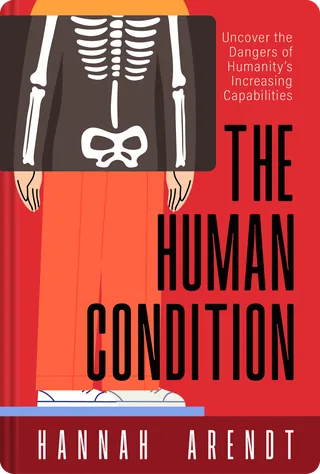
The Human Condition
Hannah Arendt
Explore how labour, creation, and action shape human freedom, meaning, and our place in modern society.
Listen to the intro
 Philosophy
 Society & Culture
Outline
What's it about?
The Human Condition (1958) examines the basic activities that make up an active human life: labour, work, and action. Hannah Arendt traces how modern society came to value production and consumption above political action and shared public life. Drawing on history and philosophy from ancient Greece to the modern age, the book asks what it means to live freely and meaningfully among other people.
Key ideas
- Arendt divides active human life into three basic activities: labour, work, and action.
- The book was published in 1958 and draws on history and philosophy from ancient Greece to the modern age.
- Modern society, Arendt argues, came to value production and consumption above political action and shared public life.
- Her central question is what it means to live freely and meaningfully among other people.
About the author
Hannah Arendt (1906–1975) was a German-born American political theorist and one of the most important thinkers of the twentieth century. She fled Nazi Germany and later taught at universities including the New School in New York. Her works include The Origins of Totalitarianism, The Human Condition, and Eichmann in Jerusalem, where she introduced the phrase the banality of evil.
Questions people ask
What is The Human Condition by Hannah Arendt about?
It examines the basic activities of an active human life: labour, work, and action. Arendt traces how modern society came to rank production and consumption above political action and shared public life.
What is the main idea of The Human Condition?
The main idea is that human freedom and meaning depend on action among other people, not only on producing and consuming. The book asks what it means to live freely and meaningfully in a shared world.
How long is the Durar summary of The Human Condition?
The Durar summary takes about 15 minutes to read or listen to. It covers the book's main ideas on labour, work, and action, and suits readers who want the core argument before tackling the full philosophical text.
You May Also Like




More in Philosophy



Get the key ideas from the world's best books in about 15 minutes
Free account · One free summary every day