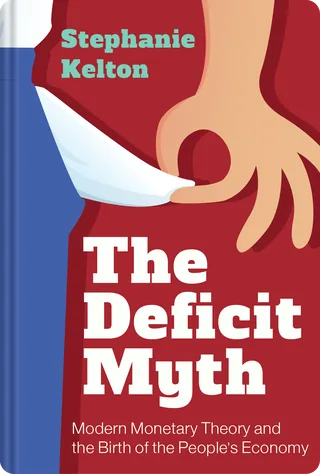
The Deficit Myth
Stephanie Kelton
Rethink government deficits and explore how currency-issuing nations could use public spending more boldly to address economic and social challenges.
Listen to the intro
 Money & Economics
 History & Politics
 Society & Culture
Outline
What's it about?
The Deficit Myth (2020) challenges the common belief that governments must manage their budgets like households. Stephanie Kelton explains the ideas of Modern Monetary Theory, arguing that countries that issue their own currency face limits set by inflation rather than by running out of money. She suggests that this view could change how governments think about spending on jobs, health, and public services.
Key ideas
- The book challenges the common belief that a government must manage its budget the way a household does.
- Stephanie Kelton explains the ideas of Modern Monetary Theory and builds her argument on them.
- Countries that issue their own currency face limits set by inflation, not by running out of money.
- Seeing the limit as inflation could change how governments think about spending on jobs, health, and public services.
About the author
Stephanie Kelton is an American economist and professor at Stony Brook University and one of the leading voices of Modern Monetary Theory. She has served as chief economist for the Democratic staff of the U.S. Senate Budget Committee and advised policymakers on economic issues. The Deficit Myth is her first book for general readers.
Questions people ask
What is the main idea of The Deficit Myth?
Stephanie Kelton argues that governments are not like households. A country that issues its own currency is limited by inflation rather than by running out of money.
Who is The Deficit Myth for?
It suits readers curious about how government budgets and deficits work, and anyone interested in Modern Monetary Theory and public spending on jobs, health, and services.
How long is the Durar summary of The Deficit Myth?
The Durar summary takes about 15 minutes to read or listen to. It covers the book's central argument about deficits, currency-issuing nations, and inflation.
You May Also Like





More in Money & Economics






Get the key ideas from the world's best books in about 15 minutes
Free account · One free summary every day