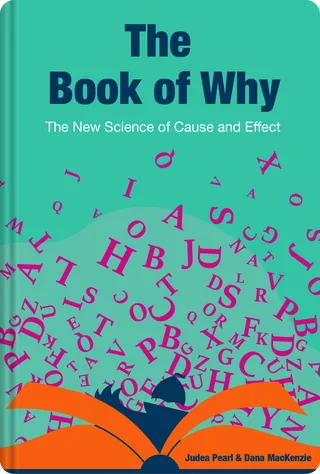
The Book of Why
Judea Pearl and Dana MacKenzie
Decode why things happen by moving beyond correlation to causal thinking that transforms science, technology, and decision-making.
Listen to the intro
 Philosophy
 Science & Technology
 Psychology
Outline
What's it about?
The Book of Why (2018) explains the new science of cause and effect. Judea Pearl and Dana MacKenzie show why data alone cannot tell us why things happen, and introduce the ladder of causation, which moves from seeing patterns to testing interventions and imagining what would have happened otherwise. The book reveals how causal thinking is changing medicine, economics, and artificial intelligence.
Key ideas
- Data alone cannot tell us why things happen; explaining causes takes more than collecting numbers.
- The book presents a new science of cause and effect that goes beyond spotting correlations.
- The ladder of causation climbs from seeing patterns, to testing interventions, to imagining what would have happened otherwise.
- Causal thinking is already changing medicine, economics, and artificial intelligence.
About the author
Judea Pearl and Dana MacKenzie combine groundbreaking research with clear science writing. Pearl is an Israeli-American computer scientist and professor at the University of California, Los Angeles, who received the Turing Award, often called the Nobel Prize of computing, for his work on probability and causal reasoning. MacKenzie is an American mathematician and award-winning science writer.
Questions people ask
What is The Book of Why about?
It explains the new science of cause and effect. Judea Pearl and Dana MacKenzie argue that data alone cannot tell us why things happen, and they introduce the ladder of causation.
What is the ladder of causation?
It is a framework with three steps: seeing patterns, testing interventions, and imagining what would have happened if things had been different.
How long is the Durar summary of The Book of Why?
The Durar summary takes about 15 minutes to read or listen to. It covers the main ideas of the book on causal thinking and how it is changing medicine, economics, and artificial intelligence.
You May Also Like




More in Philosophy





Get the key ideas from the world's best books in about 15 minutes
Free account · One free summary every day