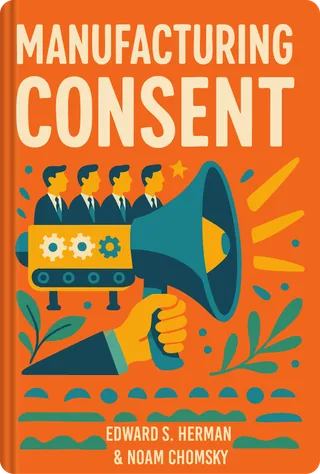
Manufacturing Consent
Edward S. Herman and Noam Chomsky
See how political and economic power shape the news, influence public opinion, and turn propaganda into accepted truth.
Listen to the intro
 History & Politics
 Society & Culture
Outline
What's it about?
Manufacturing Consent (1988) argues that the mass media in democratic societies can shape public opinion in ways that serve powerful interests, even without direct censorship. Edward S. Herman and Noam Chomsky present their propaganda model, describing how ownership, advertising, reliance on official sources, pressure from critics, and prevailing ideology act as filters on the news. The book remains a landmark in media criticism.
Key ideas
- Mass media in democratic societies can shape public opinion to serve powerful interests, even without direct censorship.
- The authors' propaganda model describes five filters that act on the news: ownership, advertising, official sources, pressure from critics, and prevailing ideology.
- Ownership and advertising influence which stories get told and how they are framed.
- Reliance on official sources means the news often reflects the views of those already in power.
- Published in 1988, the book remains a landmark in media criticism.
About the author
Edward S. Herman and Noam Chomsky combined economics and political analysis in their study of the media. Herman (1925–2017) was an American economist and professor of finance at the Wharton School of the University of Pennsylvania. Chomsky is an American linguist and political commentator at MIT, known for his theory of generative grammar and his writing on power and politics.
Questions people ask
What is Manufacturing Consent about?
It argues that mass media in democratic societies can shape public opinion in ways that serve powerful interests, without needing direct censorship. Edward S. Herman and Noam Chomsky explain this through their propaganda model.
What is the propaganda model in Manufacturing Consent?
It is the authors' framework describing five filters on the news: ownership, advertising, reliance on official sources, pressure from critics, and prevailing ideology.
Is Manufacturing Consent worth reading, and how long is the summary?
It is a landmark in media criticism, useful for anyone who wants to think about how news is produced and how opinion is shaped. The Durar summary takes about 15 minutes to read or listen to.
You May Also Like





More in History & Politics









Get the key ideas from the world's best books in about 15 minutes
Free account · One free summary every day