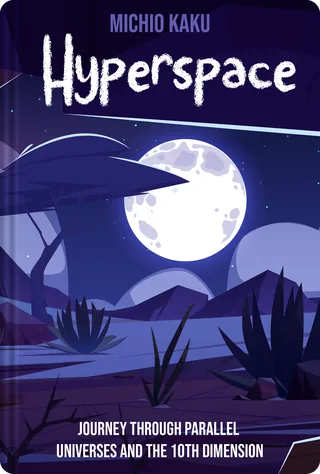
Hyperspace
Michio Kaku
Venture beyond familiar reality through higher dimensions, string theory, and wormholes that could reveal the universe’s hidden structure.
Listen to the intro
 Philosophy
 Science & Technology
Outline
What's it about?
Hyperspace (1994) introduces readers to one of the most exciting ideas in modern physics: that our universe may have more dimensions than the three we can see. Michio Kaku explains how extra dimensions could help unite the forces of nature, and explores related ideas such as wormholes, parallel universes, and time travel. The book makes advanced physics clear, exciting, and accessible.
Key ideas
- Our universe may have more dimensions than the three we can see, and Hyperspace explains why physicists take that idea seriously.
- Extra dimensions could help unite the forces of nature into a single, simpler picture of how the universe works.
- Michio Kaku explores wormholes, parallel universes, and time travel as ideas that grow out of higher-dimensional physics.
- Advanced physics can be explained in a clear, exciting way for readers who are not specialists.
About the author
Michio Kaku is an American theoretical physicist, professor at the City College of New York, and one of the world’s best-known popularisers of science. He is a co-founder of string field theory and a frequent guest on television and radio programmes about science. His bestselling books include Hyperspace, Physics of the Impossible, Physics of the Future, and The God Equation.
Questions people ask
What is the main idea of Hyperspace by Michio Kaku?
The book argues that our universe may have more dimensions than the three we can see. These extra dimensions could help unite the forces of nature.
Who is Hyperspace for?
It is for curious readers who want to understand modern physics without a technical background. Michio Kaku aims to make advanced ideas clear, exciting, and accessible.
How long is the Durar summary of Hyperspace?
The Durar summary takes about 15 minutes to read or listen to. It covers the book's key ideas, from extra dimensions to wormholes and parallel universes.
You May Also Like






More in Philosophy








Get the key ideas from the world's best books in about 15 minutes
Free account · One free summary every day