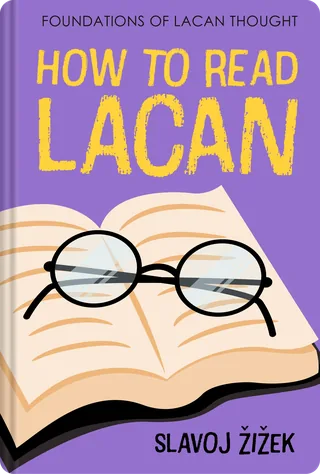
How to Read Lacan
Slavoj Žižek
Decode Lacan’s ideas on desire, identity, and reality to understand how language and symbols shape the mind and society.
Listen to the intro
 Philosophy
 Society & Culture
 Psychology
 Education & Creativity
Outline
What's it about?
How to Read Lacan (2006) is a short introduction to the ideas of Jacques Lacan, the influential French psychoanalyst. Slavoj Žižek explains difficult concepts such as the symbolic order, the unconscious, and the role of language in shaping identity, using examples from films, jokes, and everyday life. The book shows how Lacan’s thought can help readers understand culture, politics, and human behaviour.
Key ideas
- Lacan's thinking centres on desire, identity and reality, and how each is shaped by language and symbols.
- The symbolic order is a system of language and symbols that shapes how we see ourselves and the world.
- Language does more than describe the mind; it plays a role in forming identity itself.
- Žižek explains hard concepts through films, jokes and everyday life instead of dense technical argument.
- Lacan's ideas can help readers make sense of culture, human behaviour and the way society works.
About the author
Slavoj Žižek is a Slovenian philosopher and cultural critic, born in 1949, known for his lively writing on philosophy, psychoanalysis, film, and politics. He is affiliated with the University of Ljubljana and Birkbeck, University of London. His other books include The Sublime Object of Ideology.
Questions people ask
What is How to Read Lacan about?
It is a short introduction to the ideas of the French psychoanalyst Jacques Lacan, explained by Slavoj Žižek. It covers the symbolic order, the unconscious and how language shapes identity.
Who is How to Read Lacan for?
It suits readers curious about psychology, philosophy and culture who want a way into Lacan's difficult ideas. Žižek uses films, jokes and daily-life examples to make them easier to follow.
How long is the Durar summary of How to Read Lacan?
The Durar summary takes about 15 minutes to read or listen to. It gives you the main ideas of the book before you decide whether to read the full text.
You May Also Like




More in Philosophy
Get the key ideas from the world's best books in about 15 minutes
Free account · One free summary every day