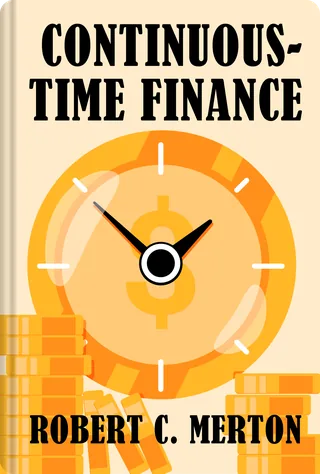
Continuous-Time Finance
Robert C. Merton
Decode financial markets through mathematical models that reveal how risk, uncertainty, and time shape asset prices and investment decisions.
Listen to the intro
 Money & Economics
 Science & Technology
Outline
What's it about?
Continuous-Time Finance (1990) is a foundational work in modern financial economics. Robert C. Merton brings together his research on how investors make decisions over time, how options and other financial instruments can be priced, and how financial markets and institutions manage risk. The book’s mathematical models have shaped the way banks, investors, and regulators understand markets.
Key ideas
- Investors make decisions continuously over time, so models of investing have to account for how choices and conditions change as time passes.
- Options and other financial instruments can be priced with mathematical models rather than by guesswork.
- Risk and uncertainty are central to how asset prices are formed in financial markets.
- Financial markets and institutions have a core job: managing risk.
- The book's mathematical models have shaped how banks, investors and regulators understand markets.
About the author
Robert C. Merton is an American economist and professor at the MIT Sloan School of Management. He shared the Nobel Prize in Economics in 1997 for his work on a new method of valuing financial options, which helped transform modern finance. His research covers risk management, investing, and retirement planning, and his books include Continuous-Time Finance.
Questions people ask
What is Continuous-Time Finance about?
It is a 1990 work by Robert C. Merton on how investors decide over time, how options and other financial instruments are priced, and how markets and institutions manage risk.
Who is Continuous-Time Finance for?
It suits readers interested in financial economics, investing and how markets work, especially those curious about the mathematical models behind asset prices and risk.
How long is the Durar summary of Continuous-Time Finance?
The Durar summary takes about 15 minutes to read or listen to. It covers the book's main ideas on time, risk and pricing, and you can choose English or Arabic.
You May Also Like





More in Money & Economics


Get the key ideas from the world's best books in about 15 minutes
Free account · One free summary every day