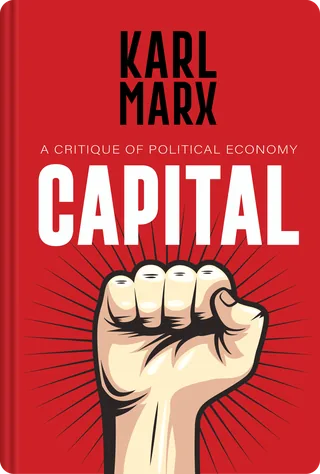
Capital
Karl Marx
Understand Marx’s critique of capitalism and how labour, wealth, exploitation, and class struggle shape inequality, power, and conflict within modern economic systems.
Listen to the intro
 Money & Economics
 History & Politics
Outline
What's it about?
Capital (1867) examines how capitalism operates through the production of commodities, the organisation of labour, and the accumulation of wealth. Karl Marx argues that profit is generated by the difference between the value workers create and the wages they receive, a process he describes through the concept of surplus value. The book analyses money, markets, industrial production, and class relations, revealing how the pursuit of capital can produce inequality, exploitation, and recurring economic crises. The first volume appeared in 1867, while the remaining volumes were published after Marx’s death.
Key ideas
- Capitalism runs on the production of commodities, the organisation of labour, and the accumulation of wealth.
- Marx argues that profit comes from the gap between the value workers create and the wages they receive.
- He calls this gap surplus value, and it is the core of his critique of capitalism.
- The book analyses money, markets, industrial production, and class relations as parts of one system.
- Marx argues that the pursuit of capital can produce inequality, exploitation, and recurring economic crises.
About the author
Karl Marx was a German philosopher, economist, historian, and political theorist whose ideas profoundly influenced modern politics, economics, and social thought. He studied capitalism, class conflict, and the relationship between economic systems and social institutions. Working closely with Friedrich Engels, he developed a critique of capitalism and argued that historical change is largely driven by struggles between social classes.
Questions people ask
What is the main idea of Capital by Karl Marx?
Marx argues that capitalist profit comes from the difference between the value workers create and the wages they are paid, which he calls surplus value. He uses this idea to explain inequality, exploitation, and economic crises.
Who is Capital for?
It suits readers interested in economic theory, political ideologies, and the history of how capitalism has been analysed. The summary is a good starting point for anyone who wants the core argument without reading the full volumes.
How long is the Durar summary of Capital?
The Durar summary takes about 15 minutes to read or listen to. It covers the book's central argument about labour, wealth, surplus value, and class relations.
You May Also Like






More in Money & Economics





Get the key ideas from the world's best books in about 15 minutes
Free account · One free summary every day