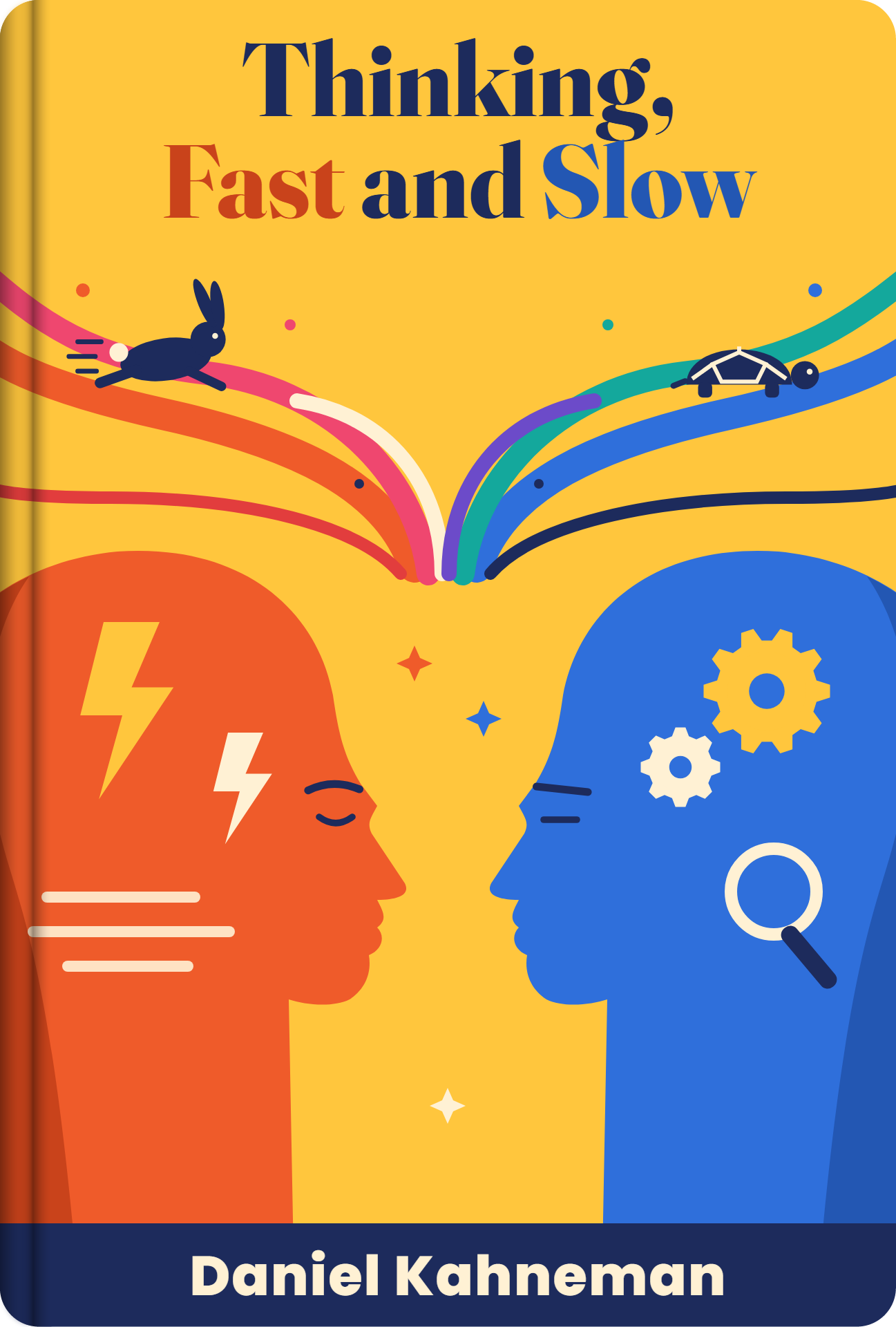
Thinking, Fast and Slow
Daniel Kahneman
Discover the two systems that drive your thinking, and learn when to trust your gut.
 Society & Culture
 Philosophy
 Personal Growth & Self-Help
 Psychology
Outline
What's it about?
Thinking, Fast and Slow (2011) explains how two systems shape every judgement we make: a fast, intuitive System 1 and a slow, deliberate System 2. Drawing on decades of research with Amos Tversky, Daniel Kahneman reveals the mental shortcuts and biases behind everyday mistakes, from anchoring and overconfidence to loss aversion, and shows how to recognise the moments when slowing down leads to better decisions.
Key ideas
- Two systems shape every judgement we make: a fast, intuitive System 1 and a slow, deliberate System 2.
- Everyday mistakes often come from mental shortcuts and biases rather than from a lack of intelligence or effort.
- Anchoring, overconfidence and loss aversion are three common biases that quietly steer our decisions.
- The book draws on decades of research Daniel Kahneman carried out together with Amos Tversky.
- Better decisions come from learning to recognise the moments when it pays to slow down.
About the author
Daniel Kahneman (1934–2024) was a psychologist and professor at Princeton University. Together with Amos Tversky, he founded the study of cognitive biases and developed prospect theory, work that earned him the Nobel Prize in Economic Sciences in 2002. Thinking, Fast and Slow became an international bestseller.
Questions people ask
What is the main idea of Thinking, Fast and Slow?
Our judgements come from two systems: a fast, intuitive System 1 and a slow, deliberate System 2. Understanding how each works helps us spot the shortcuts and biases behind common mistakes.
Who is Thinking, Fast and Slow for?
It suits anyone curious about psychology, decision-making and critical thinking, and anyone who wants to understand why they make the choices they do. No background in psychology is needed.
How long is the Durar summary of Thinking, Fast and Slow?
The Durar summary takes about 15 minutes to read or listen to. It covers the two systems, the main biases the book describes, and when slowing down leads to better decisions.
You May Also Like




More in Society & Culture




Get the key ideas from the world's best books in about 15 minutes
Free account · One free summary every day