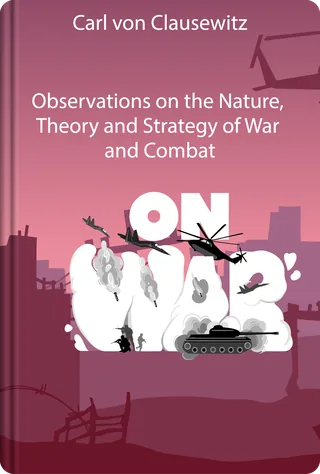
On War
Carl von Clausewitz
Understand war as an extension of politics, shaped by strategy, leadership, uncertainty, emotion, and decisions made under extreme pressure.
Listen to the intro
 Business & Career
 Philosophy
 History & Politics
Outline
What's it about?
On War (1832) is one of the most influential works ever written on military strategy. Carl von Clausewitz analyses the nature of war, famously describing it as the continuation of politics by other means, and explores ideas such as the fog of war, friction, and the relationship between government, army, and people. Published after his death, the book is still studied by military leaders, strategists, and business thinkers today.
Key ideas
- Clausewitz describes war as the continuation of politics by other means, so military action always serves a political purpose.
- The fog of war means decisions must be made with incomplete and unreliable information.
- Friction is the gap between plans and reality, where small difficulties pile up and slow everything down.
- War involves three parts that pull on each other: the government, the army, and the people.
- Leadership, emotion, and strategy all shape outcomes when decisions are made under extreme pressure.
About the author
Carl von Clausewitz (1780–1831) was a Prussian general and military theorist who fought in the Napoleonic Wars. He later directed the Prussian war college in Berlin, where he worked on his theories of war. His unfinished masterpiece, On War, was published by his wife after his death and became a foundation of modern strategic thought.
Questions people ask
What is the main idea of On War?
Clausewitz argues that war is the continuation of politics by other means. It is shaped by strategy, leadership, uncertainty, and the relationship between government, army, and people.
Who should read On War or its summary?
It suits readers interested in strategy, history, geopolitics, and critical thinking. Military leaders, strategists, and business thinkers still study it today.
How long is the Durar summary of On War?
The Durar summary takes about 15 minutes to read or listen to. It covers the book's core ideas, including the fog of war and friction, without the full length of the 1832 original.
You May Also Like







More in Business & Career




Get the key ideas from the world's best books in about 15 minutes
Free account · One free summary every day