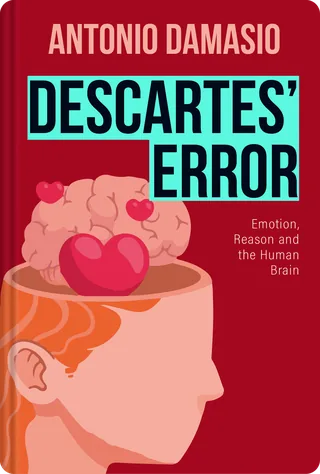
Descartes’ Error
Antonio Damasio
Rethink intelligence by seeing how emotion and reason work together to shape sound decisions and human thought.
Listen to the intro
 Health & Nutrition
 Psychology
Outline
What's it about?
Descartes’ Error (1994) challenges the old idea that reason works best when it is separated from emotion. Antonio Damasio draws on cases such as Phineas Gage and patients with damage to the frontal lobes to show that people who lose access to their feelings also lose the ability to make sound decisions. The book introduces his somatic marker hypothesis and argues that body, emotion, and reason work together to guide human behaviour.
Key ideas
- Reason does not work best when it is cut off from emotion; the two cooperate in good thinking.
- Patients with frontal lobe damage show that losing access to feelings also means losing the ability to decide soundly.
- Phineas Gage is one of the cases Damasio uses to show how brain injury can change judgement and behaviour.
- Damasio's somatic marker hypothesis proposes that signals from the body help guide the choices people make.
- Body, emotion, and reason work together to shape human behaviour, which is why the book challenges Descartes' separation of mind and feeling.
About the author
Antonio Damasio is a Portuguese-American neuroscientist and professor at the University of Southern California, where he directs the Brain and Creativity Institute. He is known for his research on emotion, decision-making, and consciousness. His books include The Feeling of What Happens, Looking for Spinoza, and Self Comes to Mind.
Questions people ask
What is the main idea of Descartes' Error?
Antonio Damasio argues that emotion is not an enemy of reason. People who lose access to their feelings also lose the ability to make sound decisions, so body, emotion, and reason must work together.
What is the somatic marker hypothesis?
It is Damasio's proposal, introduced in the book, that the body and emotion play a part in guiding human behaviour and decisions alongside reason.
How long is the Durar summary of Descartes' Error, and who is it for?
The Durar summary takes about 15 minutes to read or listen to. It suits anyone curious about psychology, decision-making, and how the brain links feeling with thinking.
You May Also Like





More in Health & Nutrition





Get the key ideas from the world's best books in about 15 minutes
Free account · One free summary every day