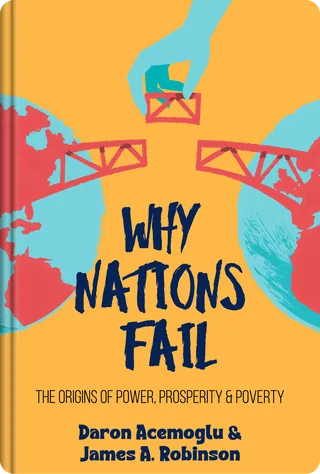
Why Nations Fail
Daron Acemoglu and James A. Robinson
Understand why some nations prosper while others remain poor—and how inclusive or extractive institutions shape their fate.
Listen to the intro
 Business & Career
 Money & Economics
 History & Politics
Outline
What's it about?
Why Nations Fail (2012) asks why some countries become rich while others remain poor. Daron Acemoglu and James A. Robinson argue that the answer lies not in geography or culture, but in institutions. Using examples from across history, they show that inclusive political and economic institutions encourage innovation and prosperity, while extractive institutions that serve a small elite hold nations back.
Key ideas
- Some countries become rich while others stay poor, and the book looks for the cause behind that gap.
- The authors argue that geography and culture are not the answer; institutions are.
- Inclusive political and economic institutions encourage innovation and prosperity.
- Extractive institutions serve a small elite and hold a nation back.
- The authors draw examples from across history to show how institutions shape a nation's fate.
About the author
Daron Acemoglu and James A. Robinson are two of the world’s leading economists and longtime collaborators. Acemoglu is a Turkish-American economist at MIT, and Robinson is a British economist and political scientist at the University of Chicago. In 2024 they shared the Nobel Memorial Prize in Economic Sciences for their research on how institutions shape prosperity.
Questions people ask
What is the main idea of Why Nations Fail?
Acemoglu and Robinson argue that a nation's wealth or poverty depends mainly on its institutions, not on geography or culture. Inclusive institutions support prosperity, while extractive ones hold nations back.
Who is Why Nations Fail for?
It suits readers curious about economics, history, politics and governance who want to understand why some countries prosper and others stay poor. No specialist background is needed to follow the central argument.
How long is the Durar summary of Why Nations Fail?
The Durar summary takes about 15 minutes to read or listen to. It covers the book's central argument about inclusive and extractive institutions and how they shape nations.
You May Also Like







More in Business & Career









Get the key ideas from the world's best books in about 15 minutes
Free account · One free summary every day