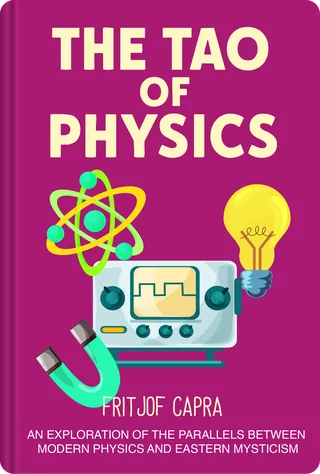
The Tao of Physics
Fritjof Capra
Connect modern physics with Eastern philosophy to uncover striking parallels between quantum theory, relativity, and ancient views of reality.
Listen to the intro
 Religion & Spirituality
 Philosophy
 Science & Technology
Outline
What's it about?
The Tao of Physics (1975) explores parallels between concepts in modern physics and ideas found in several Eastern philosophical traditions. It presents these connections as a philosophical perspective that can broaden reflection on nature rather than as scientific proof of spiritual teachings.
Key ideas
- The book explores parallels between concepts in modern physics and ideas found in several Eastern philosophical traditions.
- It points to similarities between quantum theory, relativity, and ancient views of reality.
- Capra offers these connections as a philosophical perspective that can broaden how we reflect on nature.
- The parallels are not presented as scientific proof of spiritual teachings.
About the author
Fritjof Capra is an Austrian-born physicist, author, and systems thinker. His work examines connections among science, ecology, society, and the interconnected nature of complex systems.
Questions people ask
What is The Tao of Physics about?
Published in 1975, it explores parallels between concepts in modern physics and ideas found in several Eastern philosophical traditions. It links quantum theory and relativity with ancient views of reality.
Does The Tao of Physics prove that physics and spirituality agree?
No. Fritjof Capra presents the connections as a philosophical perspective that can broaden reflection on nature, not as scientific proof of spiritual teachings.
How long is the Durar summary of The Tao of Physics?
The Durar summary takes about 15 minutes to read or listen to. It covers the book's main idea about the parallels between modern physics and Eastern philosophy.
You May Also Like


More in Religion & Spirituality




Get the key ideas from the world's best books in about 15 minutes
Free account · One free summary every day