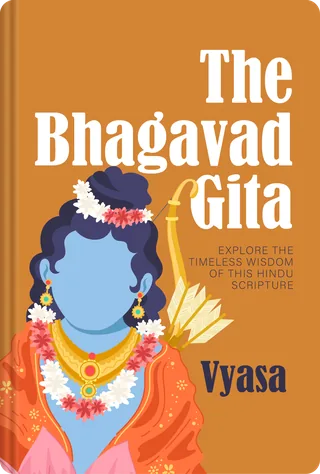
The Bhagavad Gita
Vyasa
Find purpose amid conflict and doubt by aligning your actions with wisdom, duty, and freedom from attachment to outcomes.
Listen to the intro
 Religion & Spirituality
 Philosophy
 Society & Culture
Outline
What's it about?
The Bhagavad Gita (c. 2nd century BCE to 2nd century CE) is an ancient spiritual and philosophical text presented as a dialogue between Prince Arjuna and Krishna. It reflects on duty, moral action, devotion, self-discipline, and the search for inner steadiness during difficult decisions.
Key ideas
- The Bhagavad Gita is an ancient text framed as a dialogue between Prince Arjuna and Krishna.
- It reflects on duty and moral action, especially when a decision is difficult.
- The book values acting according to wisdom and duty rather than clinging to outcomes.
- It explores devotion and self-discipline as ways to find inner steadiness.
- Its central search is for purpose and calm in the middle of conflict and doubt.
About the author
Vyasa is the sage to whom Hindu tradition attributes the composition of the Mahabharata, which contains the Bhagavad Gita. He holds an important place in the literary and spiritual heritage of India.
Questions people ask
What is the main idea of the Bhagavad Gita?
The main idea is to find purpose amid conflict and doubt by aligning your actions with wisdom and duty. It also teaches freedom from attachment to outcomes.
Who are the speakers in the Bhagavad Gita?
The text is a dialogue between Prince Arjuna and Krishna. They discuss duty, moral action, devotion and self-discipline during difficult decisions.
How long is the Durar summary of the Bhagavad Gita?
The Durar summary takes about 15 minutes to read or listen to. It covers the book's reflections on duty, moral action and inner steadiness.
You May Also Like





More in Religion & Spirituality








Get the key ideas from the world's best books in about 15 minutes
Free account · One free summary every day