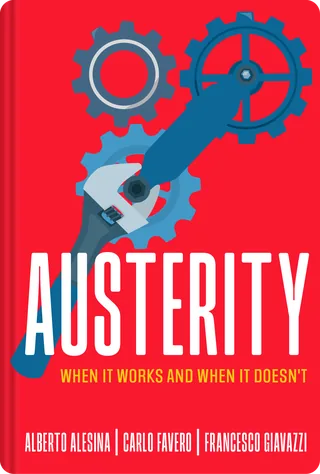
Austerity
Alberto Alesina, Carlo Favero and Francesco Giavazzi
Understand when austerity supports recovery and when it deepens crisis through evidence that challenges conventional economic thinking.
Listen to the intro
 Money & Economics
 History & Politics
 Society & Culture
Outline
What's it about?
Austerity (2019) examines what happens when governments cut spending or raise taxes to reduce public debt. Using data from many countries over several decades, Alberto Alesina, Carlo Favero and Francesco Giavazzi show that spending cuts tend to cause milder slowdowns than tax increases, and that the design and timing of austerity matter a great deal. The book offers an evidence-based contribution to a heated policy debate.
Key ideas
- Austerity means a government cutting spending or raising taxes in order to reduce its public debt.
- The authors study data from many countries over several decades rather than relying on theory alone.
- Spending cuts tend to cause milder economic slowdowns than tax increases.
- How austerity is designed and when it is carried out matters a great deal for its results.
- The book offers evidence to a heated policy debate and challenges conventional economic thinking.
About the author
Alberto Alesina, Carlo Favero and Francesco Giavazzi are leading Italian economists who have studied fiscal policy for decades. Alesina (1957–2020) was a professor of economics at Harvard University and an influential researcher on politics and economics. Favero and Giavazzi are professors at Bocconi University in Milan and experts on macroeconomics and public finance.
Questions people ask
What is the main idea of the book Austerity?
The book argues that austerity does not always deepen a crisis. Spending cuts tend to cause milder slowdowns than tax increases, and the design and timing of austerity matter a great deal.
Who wrote Austerity and what evidence does it use?
It was written by Alberto Alesina, Carlo Favero and Francesco Giavazzi in 2019. They draw on data from many countries over several decades.
How long is the Durar summary of Austerity?
The Durar summary takes about 15 minutes to read or listen to. It is useful for anyone curious about how governments handle public debt and what the evidence says about it.
You May Also Like







More in Money & Economics






Get the key ideas from the world's best books in about 15 minutes
Free account · One free summary every day