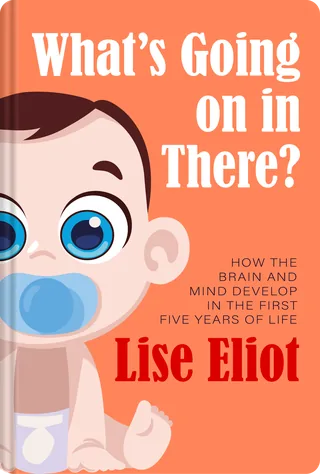
What’s Going on in There?
Lise Eliot
Shape your child’s developing brain through everyday interactions that strengthen thinking, emotional health, learning, and future growth.
Listen to the intro
 Psychology
 Parenting
Outline
What's it about?
What’s Going on in There? (1999) explains how a child’s brain and mind develop from before birth through the first five years of life. Lise Eliot describes how each sense, movement skill, emotion, and language ability grows, and shows how genes and everyday experiences work together. The book gives parents a clear, science-based picture of early development and practical ways to support it.
Key ideas
- A child's brain and mind begin developing before birth and keep growing through the first five years of life.
- Each sense, movement skill, emotion, and language ability develops in its own way, and the book explains how.
- Genes and everyday experiences work together to shape how a child develops; neither acts alone.
- Ordinary daily interactions with a child can strengthen thinking, emotional health, and learning.
- The book gives parents a clear, science-based picture of early development along with practical ways to support it.
About the author
Lise Eliot is an American neuroscientist and professor at Rosalind Franklin University of Medicine and Science in Chicago. Her research and writing focus on brain development in children and how it is shaped by experience. Her books include What’s Going on in There? and Pink Brain, Blue Brain.
Questions people ask
Who is What's Going on in There? for?
It is written for parents who want to understand how their child's brain and mind develop in the first five years. It suits anyone interested in child development, parenting, or psychology.
What is the main idea of What's Going on in There? by Lise Eliot?
Genes and everyday experiences work together to build a child's brain, from before birth through age five. Parents can support that growth through daily interactions.
How long does the Durar summary of What's Going on in There? take?
The Durar summary takes about 15 minutes to read or listen to. It covers the book's main ideas on early brain development and how parents can support it.
You May Also Like







More in Psychology









Get the key ideas from the world's best books in about 15 minutes
Free account · One free summary every day