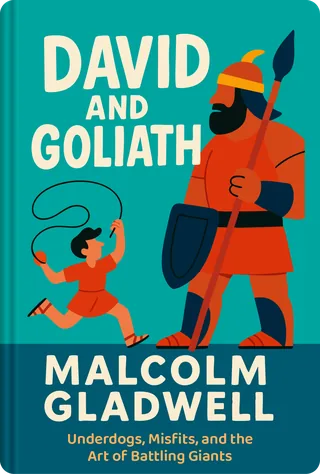
David and Goliath
Malcolm Gladwell
Turn disadvantages into hidden strengths and discover how struggle, courage, and unconventional thinking help underdogs overcome powerful opponents.
Listen to the intro
 Personal Growth & Self-Help
 Society & Culture
Outline
What's it about?
David and Goliath (2013) challenges how we think about advantages and disadvantages. Malcolm Gladwell shows that underdogs often win because what looks like a weakness can become a strength, and what looks like power can hide serious limits. With stories from education, medicine, sport, and history, the book encourages readers to rethink obstacles and see new possibilities in difficult situations.
Key ideas
- What looks like a weakness can turn into a real strength when you use it differently.
- What looks like power can hide serious limits that an opponent can exploit.
- Underdogs often win because struggle, courage and unconventional thinking give them options stronger opponents lack.
- Gladwell draws his stories from education, medicine, sport and history to challenge how we judge advantages and disadvantages.
- Rethinking an obstacle can reveal new possibilities in a difficult situation.
About the author
Malcolm Gladwell is a Canadian journalist and author and a longtime staff writer for The New Yorker. He is known for making research in psychology and social science engaging through storytelling, and he hosts a popular podcast. His bestselling books include The Tipping Point, Blink, Outliers, David and Goliath, and Talking to Strangers.
Questions people ask
What is the main idea of David and Goliath by Malcolm Gladwell?
The book argues that advantages and disadvantages are not what they seem. Underdogs often win because their apparent weakness becomes a strength, while apparent power can hide serious limits.
Who is David and Goliath for?
It suits readers interested in resilience, motivation and how society thinks about strength and weakness. Anyone facing a difficult situation may find a useful way to rethink it.
How long is the Durar summary of David and Goliath?
The Durar summary takes about 15 minutes to read or listen to. It covers the book's central argument and the kinds of stories Gladwell uses to support it.
You May Also Like






More in Personal Growth & Self-Help







Get the key ideas from the world's best books in about 15 minutes
Free account · One free summary every day