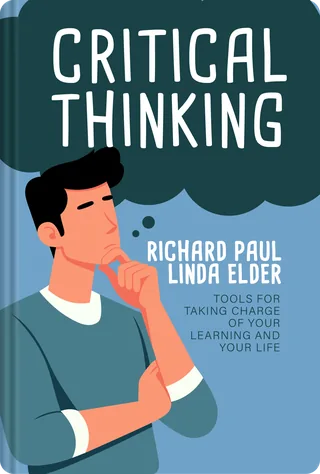
Critical Thinking
Richard Paul and Linda Elder
Elevate your thinking by questioning assumptions, analysing information clearly, and making sharper decisions with greater purpose.
Listen to the intro
 Personal Growth & Self-Help
 Philosophy
 Education & Creativity
Outline
What's it about?
Critical Thinking (2006) introduces practical tools for examining assumptions, evaluating evidence, asking clear questions, and reaching well-supported conclusions. It encourages readers to recognise bias, consider different viewpoints, and apply consistent intellectual standards to everyday decisions.
Key ideas
- Examine your own assumptions before accepting a conclusion, because unexamined assumptions quietly shape what you believe.
- Evaluate evidence carefully and check whether it actually supports the claim being made.
- Ask clear, precise questions, since vague questions lead to vague answers and weak decisions.
- Learn to recognise bias in yourself and in others, and consider viewpoints different from your own.
- Apply the same intellectual standards consistently to everyday decisions, not only to big problems.
About the author
Richard Paul (1937–2015) and Linda Elder became influential educators and authors in the field of critical thinking. Paul founded the Center for Critical Thinking, while Elder is an educational psychologist who has led programmes dedicated to improving reasoning and intellectual discipline.
Questions people ask
What is Critical Thinking by Richard Paul and Linda Elder about?
It offers practical tools for questioning assumptions, evaluating evidence, asking clear questions and reaching well-supported conclusions. The aim is better, more purposeful decisions.
Who is Critical Thinking for?
It suits anyone who wants to think more clearly and decide more carefully, including students, teachers and professionals. Its tools are meant for everyday decisions, not only academic work.
How long is the Durar summary of Critical Thinking?
The Durar summary takes about 15 minutes to read or listen to. It covers the book's main tools for examining assumptions, spotting bias and judging evidence.
You May Also Like


More in Personal Growth & Self-Help

Get the key ideas from the world's best books in about 15 minutes
Free account · One free summary every day