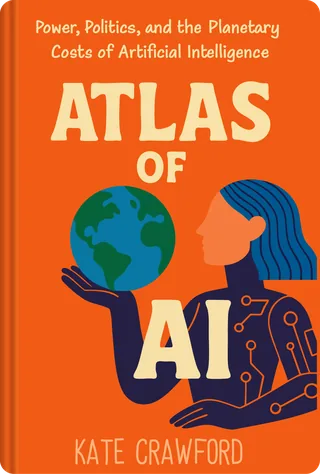
Atlas of AI
Kate Crawford
Expose the hidden labour, mineral extraction, and environmental costs behind AI, challenging its image as clean and neutral technology.
Listen to the intro
 Business & Career
 History & Politics
 Society & Culture
 Nature & the Environment
Outline
What's it about?
Atlas of AI (2021) shows that artificial intelligence is not just clever software but a system built on physical resources, human labour, and large amounts of data. Kate Crawford follows AI from the mines that supply minerals for computers to the workers who label data and the ways AI is used to classify and monitor people. The book raises important questions about power, fairness, and the true costs of AI.
Key ideas
- Artificial intelligence is not just clever software but a system built on physical resources, human labour, and large amounts of data.
- AI can be traced back to the mines that supply the minerals computers need.
- Workers who label data are a hidden part of how AI systems come to exist.
- AI is also used to classify and monitor people, which raises questions about power and fairness.
- Crawford asks readers to consider the true costs of AI instead of accepting its image as clean and neutral.
About the author
Kate Crawford is an Australian scholar and author who studies the social and political effects of artificial intelligence. She has held senior research positions at Microsoft Research and the University of Southern California and co-founded research groups focused on AI and society. Her book Atlas of AI has received international awards.
Questions people ask
What is Atlas of AI about?
Atlas of AI by Kate Crawford argues that artificial intelligence depends on minerals, human labour, and huge amounts of data. It follows AI from the mines to the workers who label data and the systems that classify and monitor people.
Who should read Atlas of AI?
It suits anyone curious about the real-world costs of AI, including readers interested in technology, business, society, or the environment. No technical background is needed to follow its central argument.
How long is the Durar summary of Atlas of AI?
The Durar summary takes about 15 minutes to read or listen to. It covers the book's main argument about the hidden labour, resources, and costs behind AI.
You May Also Like





More in Business & Career







Get the key ideas from the world's best books in about 15 minutes
Free account · One free summary every day